Many organisations invest significant resources in safety management systems, procedures, and compliance frameworks. While these controls are essential, serious incidents can still occur in organisations that appear compliant.
In many cases, the underlying issue is not the absence of procedures, but how safety is experienced and prioritised within the organisation’s culture. The ProGuard Safety Culture Diagnostic provides organisations with a structured safety culture assessment designed to identify the cultural and behavioural factors that influence safety performance.
By examining leadership behaviours, workforce engagement, and operational pressures, the diagnostic helps organisations understand how decisions are made in real operational environments.
This insight enables leaders to strengthen safety culture, improve operational risk management, and move beyond compliance-driven safety management.
The ProGuard Safety Culture Diagnostic provides organisations with a structured safety culture assessment, leadership insight, and cultural maturity analysis to improve safety performance.

Safety culture plays a critical role in determining how work is carried out in practice. While policies, procedures, and compliance systems provide the foundation for managing risk, it is the organisation’s culture that ultimately shapes how individuals behave and make decisions in operational environments.
Leadership behaviours, workforce attitudes, and operational pressures all influence whether safety standards are consistently maintained. When safety culture is strong, organisations are better able to maintain safe decision-making even when productivity demands or operational pressures increase.
Understanding safety culture therefore provides leaders with valuable insight into the factors that influence safety performance and organisational risk.
The ProGuard Safety Culture Diagnostic provides leadership teams with a clear understanding of the cultural drivers that influence safety performance.
The diagnostic identifies insights across several critical areas:
How leadership behaviour shapes safety priorities and expectations across the organisation.
Whether employees feel confident raising safety concerns and challenging unsafe behaviour.
How deadlines, productivity targets, and operational demands influence safety decision-making.
Where the organisation sits within the ProGuard Cultural Maturity Model.
How behaviours observed in operational environments reflect the organisation’s safety culture.

The ProGuard Safety Culture Diagnostic combines several assessment methods to provide a comprehensive understanding of safety culture.
A structured workforce survey capturing perceptions of safety leadership, communication, and behavioural safety.
Observation of operational environments to assess how work is carried out in practice.
Evaluation using the ProGuard Cultural Maturity Model, identifying whether the organisation operates at a reactive, compliance, engaged, integrated, or transformational level.
Diagnostic findings presented through a visual culture dashboard highlighting key cultural indicators.
Organisations completing the ProGuard Safety Culture Diagnostic receive a comprehensive insight into their safety culture.
These insights enable leadership teams to understand cultural risks and develop a clear strategy for improving safety culture.

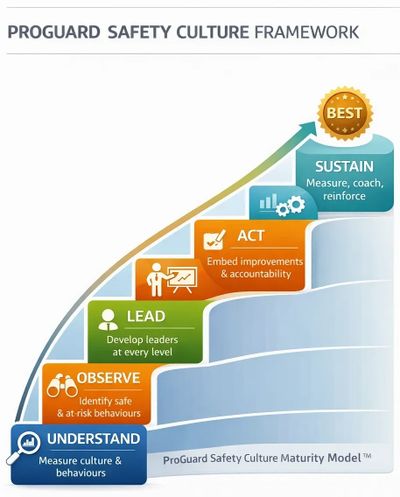
The Safety Culture Diagnostic forms the first stage of the ProGuard Safety Culture Framework, which provides organisations with a structured pathway for strengthening safety culture.
The framework consists of five stages:
Assess how safety culture currently operates.
Understand how work is carried out in operational environments.
Strengthen leadership behaviours that influence safety culture.
Implement targeted improvements to address cultural risks.
Maintain high safety standards through continuous measurement and leadership engagement.
The Safety Culture Diagnostic is particularly valuable for organisations that:
Understanding safety culture is the first step toward improving it.
The ProGuard Safety Culture Diagnostic provides leaders with clear insight into cultural maturity, leadership influence, and workforce engagement.
If you would like to understand how safety culture operates within your organisation, contact ProGuard Consulting to request a Safety Culture Diagnostic.
Contact ProGuard Consulting
Email: info@proguardconsulting.co.uk
Phone: 07595 893659.
Even organisations with strong safety management systems can experience a gradual decline in safety culture over time. This often occurs slowly and may not immediately appear in incident statistics or audit results.
Recognising the early warning signs of a weakening safety culture allows organisations to address underlying issues before they develop into serious incidents.
Below are five common indicators that safety culture may be weakening within an organisation.
Operational environments often involve deadlines, production targets, and commercial pressures. When safety culture begins to weaken, procedures may gradually be adapted or bypassed in order to meet these demands.
Examples may include:
Over time these behaviours can become accepted, increasing the likelihood of incidents.
A strong safety culture encourages open communication about risks and hazards. When safety culture weakens, employees may become less willing to report issues or challenge unsafe behaviour.
This may occur when:
When employees stop raising concerns, valuable insight into operational risk can be lost.
Leadership behaviour plays a critical role in shaping safety culture. When leaders are less visible in operational environments or safety discussions become less prominent, employees may interpret this as a signal that safety is no longer a priority.
This can lead to:
Visible leadership engagement is essential for reinforcing safety expectations across the organisation.
One of the most common drivers of cultural decline is operational pressure. When productivity targets or deadlines begin to influence safety decisions, employees may feel pressure to prioritise speed or output over safe working practices.
Indicators may include:
Understanding how operational pressure affects behaviour is a key part of managing safety culture.
Recognising these warning signs is the first step toward strengthening safety culture.
The ProGuard Safety Culture Diagnostic helps organisations assess leadership behaviours, workforce engagement, and operational pressures that influence safety performance. By gaining a clearer understanding of these cultural factors, organisations can take targeted action to strengthen safety culture and reduce operational risk.
Strong safety performance is rarely achieved through procedures and compliance systems alone. While these elements are essential, the effectiveness of any safety management system ultimately depends on the culture of the organisation and the behaviours it encourages.
For boards and senior leadership teams, understanding safety culture is therefore a critical part of managing operational risk and ensuring that safety standards are consistently maintained across the organisation.
Below are three important questions every board should consider when assessing the strength of their organisation’s safety culture.
Operational environments inevitably involve deadlines, production targets, and commercial pressures. While these pressures are often unavoidable, they can influence how decisions are made at operational levels.
Boards should consider whether safety standards remain consistent when operational pressure increases, or whether work practices begin to change in order to meet deadlines or productivity demands.
Understanding how operational pressure influences behaviour is a key indicator of safety culture strength.
Leadership behaviour plays a critical role in shaping organisational culture. Employees observe how leaders respond to competing priorities and often take cues from these behaviours when making their own decisions.
Boards should consider whether leaders across the organisation consistently demonstrate that safety is a priority, particularly during challenging operational situations.
Visible leadership commitment and consistent safety messaging help reinforce expectations and support strong safety cultures.
A strong safety culture is characterised by open communication and trust. Employees should feel confident raising safety concerns, reporting hazards, and challenging unsafe practices without fear of negative consequences.
Boards should consider whether employees feel comfortable speaking up about safety issues and whether feedback from frontline teams is actively used to improve safety performance.
Organisations that encourage open communication gain valuable insight into operational risks and are better positioned to prevent incidents.
For many organisations, these questions can be difficult to answer without structured insight into how safety culture operates across the business.
The ProGuard Safety Culture Diagnostic provides leadership teams with a structured safety culture assessment, examining leadership behaviours, workforce perceptions, and operational pressures that influence safety performance.
By gaining a clearer understanding of these cultural drivers, boards and senior leaders can strengthen safety leadership, improve decision-making, and ensure that safety standards are consistently maintained across the organisation.
Want to understand the strength of your organisation’s safety culture?
Many organisations involved in serious incidents are often found to have documented safety procedures, risk assessments, and compliance systems already in place. They may have completed audits, delivered training programmes, and implemented formal safety management systems aligned with recognised standards.
Despite this, serious incidents can still occur.
This highlights an important reality: compliance alone does not always determine how work is carried out in practice.
While procedures and systems establish expectations for safe working, everyday operational decisions are influenced by a range of cultural and behavioural factors. Operational pressure, leadership signals, workforce attitudes, and organisational priorities can all affect how individuals interpret procedures and respond to risk.
In many cases, incidents occur when small behavioural changes gradually emerge within operational environments. Shortcuts may begin to appear, procedures may be interpreted more flexibly, or risks may be tolerated in order to meet deadlines or productivity targets. Over time, these changes can become normalised, gradually weakening adherence to safety standards even though formal systems remain in place.
This process is often referred to as cultural drift, where the way work is actually carried out slowly moves away from the way it was originally designed to be performed safely.
Understanding these cultural dynamics is essential for organisations seeking to improve safety performance and manage operational risk more effectively. By examining leadership behaviours, workforce engagement, and operational pressures, organisations can gain valuable insight into the cultural factors that influence safety decisions in everyday work.
The ProGuard Safety Culture Diagnostic helps organisations identify these underlying cultural influences, providing leaders with clear insight into how safety culture operates across the organisation and where improvements may be required.
Safety culture is often discussed as a workforce issue, but in reality it is strongly influenced by leadership behaviour. Employees closely observe how leaders prioritise safety when competing demands arise.
When leaders consistently reinforce safety expectations and demonstrate visible commitment, it sends a clear signal throughout the organisation.
Conversely, when operational priorities appear to take precedence over safety standards, employees may begin to interpret these signals differently. Over time this can influence how individuals approach risk and how strictly procedures are followed.
Strong safety cultures are typically characterised by leadership teams who actively engage with frontline operations, encourage open communication about safety concerns, and consistently reinforce the importance of maintaining safety standards.
Operational environments rarely operate without pressure. Deadlines, productivity targets, and commercial demands are a normal part of most industries. However, these pressures can influence how individuals make decisions about risk.
When operational pressure increases, individuals may begin to adapt procedures in order to complete work more quickly or efficiently. While these changes may initially appear minor, repeated adaptations can gradually alter how work is performed across the organisation.
This dynamic is often described using the Pressure vs Standards model, which illustrates how increasing operational pressure can gradually weaken adherence to safety standards. Organisations that understand this relationship are better able to recognise early warning signs and reinforce safe decision-making even during challenging operational conditions.
Many organisations attempt to assess safety performance using incident statistics, audits, and compliance indicators. While these metrics provide valuable information, they often focus on past events rather than the cultural factors influencing future risk.
Safety culture assessments provide a broader understanding of how safety is experienced across the organisation. These assessments typically examine leadership behaviours, workforce perceptions, reporting culture, and operational pressures that influence decision-making.
By measuring these cultural indicators, organisations can gain insight into how safety culture operates in practice and identify areas where leadership engagement, workforce communication, or behavioural standards may need strengthening.
The ProGuard Safety Culture Diagnostic provides organisations with structured insight into these cultural factors, helping leadership teams understand the drivers of safety performance and identify opportunities for improvement.
Downloadable ProGaurd Safety Culture Self-Assessment Checklist
ProGuard Safety Culture Self-Assessment Checklist (pdf)
DownloadCopyright © 2025 ProGuard Consulting - All Rights Reserved.
Address: The Office, 26 Thingwall Rd, Irby, Birkenhead, Wirral CH61 3UE
email: Info@proguardconsulting.co.uk
Tel: +44 07595893659